
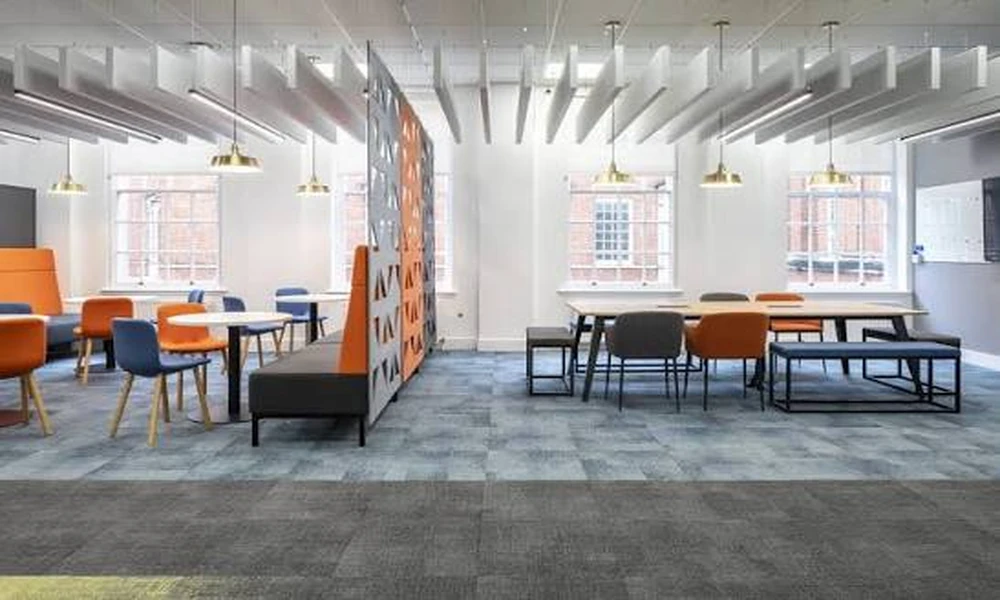

Open offices and shared spaces are designed to bring people together. They make collaboration easier, encourage interaction, and help teams stay connected throughout the day.
But spend enough time in one, and you’ll notice something else. Sound travels.
A quick conversation nearby turns into background noise. Phone calls overlap. Movement, typing, and general activity all start to layer together. None of it is particularly loud on its own, but combined, it can make the space feel harder to work in.
That’s where acoustic sound panels come in. They don’t remove activity from a space, but they help manage how that activity is experienced.
Why Open Spaces Feel More Distracting
Unlike enclosed rooms, open offices don’t have many physical barriers to stop sound from spreading.
Voices carry further, and without walls to contain them, conversations can be heard across large areas. Add in hard surfaces like desks, glass partitions, and ceilings, and sound reflects even more.
This creates a constant layer of background activity. Over time, that can make it difficult to concentrate or hold focused conversations.
What Sound Panels Actually Do
Sound panels are designed to absorb sound rather than reflect it.
When sound hits untreated surfaces, it bounces back into the space. When it hits a panel, much of that energy is absorbed.
This reduces the number of reflections in the room. The result is a more controlled environment where sound doesn’t spread as aggressively.
It’s not about making the office silent. It’s about reducing the build-up that leads to distraction.
Containing Conversations Within Zones
One of the biggest benefits of sound panels in open spaces is how they help contain conversations.
Without any acoustic treatment, a discussion at one desk can easily be heard across the room. This makes it harder for others to focus, even if they’re not part of the conversation.
Panels help keep sound more localised. Conversations stay closer to where they happen instead of spreading across the entire space.
This makes it easier for teams to work side by side without constantly affecting each other.
Improving Speech Clarity
Sound panels also improve how clearly people can hear each other.
In untreated spaces, reflections can cause speech to feel slightly blurred. You might catch most of what’s being said, but not as effortlessly as you should.
By reducing these reflections, panels make voices sound more direct and easier to understand.
This is especially useful in shared spaces where quick, clear communication is part of daily work.
Supporting Focus Without Isolating People
One of the challenges of open offices is finding a balance between collaboration and focus.
Completely isolating people defeats the purpose of the layout. But leaving the space untreated can make it difficult to concentrate.
Sound panels help strike that balance.
They reduce the spread of sound without blocking interaction. People can still communicate easily, but the overall environment feels more manageable.
Making Shared Spaces More Comfortable
It’s not just offices that benefit from sound panels.
Co-working spaces, lounges, libraries, and other shared environments all deal with similar challenges. Multiple people using the same space at the same time creates a mix of different sounds.
Panels help smooth out that mix. Instead of noise building up, the space feels more balanced and comfortable.
This improves the experience for everyone using it.
Placement Matters More Than Quantity
As with most acoustic solutions, where you place panels matters more than how many you install.
Panels are most effective when positioned:
- Near workstations or seating areas
- On large reflective walls
- On ceilings above high-activity zones
Spreading panels across the space helps manage sound more evenly. Concentrating them in one area often leads to uneven results.
A thoughtful layout makes a bigger difference than simply adding more panels.
Ceiling Panels Play A Key Role
In open offices, ceilings are often one of the largest reflective surfaces.
Sound travels upward and reflects back down into the space. Without treatment, this contributes to the overall build-up of sound.
Ceiling panels or acoustic baffles help intercept this. They reduce how much sound is reflected back into the room, improving the overall acoustic balance.
Combining wall and ceiling treatment usually gives the best results.
Design Can Still Take Priority
There’s sometimes a concern that adding sound panels will affect the look of the space.
Modern panels are designed with this in mind. They come in a variety of styles, colours, and finishes, allowing them to fit into different design concepts.
Some panels are subtle and blend into the background, while others are used as design features.
This makes it possible to improve acoustics without compromising the overall aesthetic.
The Long-Term Impact On Productivity
The effects of sound panels aren’t always dramatic right away, but they build over time.
When the environment feels easier to work in, people can concentrate for longer periods. Conversations become clearer, and there’s less need to repeat information.
These small improvements add up, leading to better productivity and a more comfortable workspace.
Final Thoughts
Open offices and shared spaces are designed to support collaboration, but without proper acoustic control, they can become distracting.
Sound panels help manage how sound behaves, reducing the spread of noise and improving clarity without removing the energy of the space.
It’s a practical way to make shared environments work better for everyone. And once the balance is right, the difference is something people notice every day.
