

People ask this a lot, and it is one of those questions that sounds simple but actually has a few layers to it. The short answer is: sort of, and it depends. Let me explain what actually happens.
What About After Sunset?
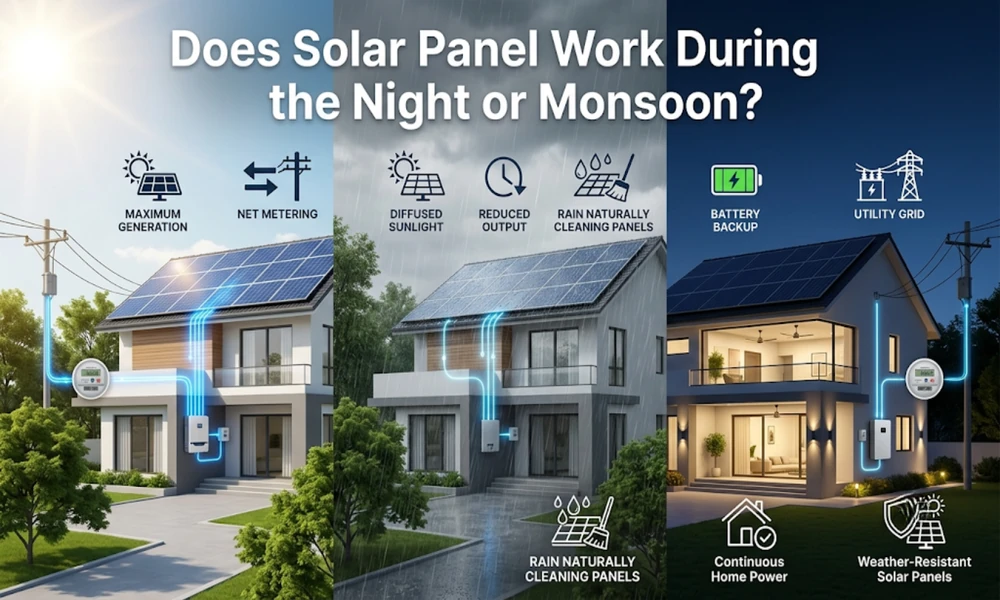
Sunlight is required for the production of electricity in the solar panels, hence they do not work at night. It’s that simple. The real question, however, is, do your lights go off at night? And most people get it all wrong.
In India, most solar rooftops are connected to the electrical grid through a net metering system. During the daytime, the electricity produced by the solar panels that exceeds the requirements of your household is exported to the grid. After the sun sets, all you have to do is draw from the grid just like normal. The electricity you had added to the grid before becomes something like a credit that offsets the consumption after dark.
Some households take this concept one step further by including batteries in the system. Batteries store excess electricity that is produced in the daytime and deliver the same when the panels are not working. This has proved to be quite beneficial in areas that suffer from frequent power cuts.
What Happens When the Monsoon Season Begins?
Here comes the tricky part. The panels don’t simply turn off when the clouds appear. They keep working, just at a lower output, because diffused light still gets through cloud cover. How much lower it is depends on how heavy the cloud cover is, how hard it is raining, the efficiency of your panels, and how well the system has been maintained.
One thing the monsoon actually does help with is cleaning. Dust and grime build up on panels over time and quietly reduce how much power they generate. A good spell of rain washes that off and brings performance back up once the skies clear.
Good quality panels and solid mounting structures are also built to handle heavy rain, high humidity, and wind without any issues, so weather damage is rarely a concern with a properly installed system.
How Much Capacity Does Your Home Need?
This comes down to how much electricity your household uses, how much usable roof space you have, and what the solar conditions are like in your area. For most Indian homes, a system in the 3 kW to 7 kW range can cover a meaningful share of monthly consumption.
As a rough benchmark, every 1 kW of solar capacity needs around 80 to 100 square feet of shadow-free roof space and can produce roughly 4 to 5 units of electricity per day when conditions are good.
Given how varied the climate is across India, the quality of your panels matters more than most people realise. Waaree, with over 25.8 GW of manufacturing capacity, makes TOPCon and HJT solar modules that are built to perform consistently across different weather conditions, so your system keeps delivering even when the weather does not cooperate.
